
What is gum arabic?

Gum arabic is a natural resin that comes from the sap of acacia trees, specifically Acacia senegal or Acacia seyal. These trees grow across parts of Africa and the Middle East. 12 The resin is been referred to as “gum arabic” in English because historically, African gums traveled to Europe through Middle Eastern trade ports.3
It is typically edible and can be used as a glue, thickener, stabilizer, or binder depending on the context. Today, we find it in all kinds of food products including soft drinks. In the ancient, medieval, and Renaissance eras, it also had many uses.
The resin itself is difficult to synthesize and thus is still used in its natural form.

Early uses of gum arabic in art
Gum arabic was used extensively by Egyptians in art and in daily life. Scribes used it as a binder for both ink and paint. It was also used in the creation of papyrus to adhere strips of material.
Greek and Roman scholars wrote frequently of the gum and its uses. It was mainly prized for its perceived medicinal properties, such as the ability to stop wounds from bleeding. Pliny the Elder also described Gum Arabic as an early ingredient used by artists:
“The preparation of all black is completed by exposure to the sun, black for writing ink receiving an admixture of gum and black for painting walls an admixture of glue. Black pigment that has been dissolved in vinegar is difficult to wash out.”4
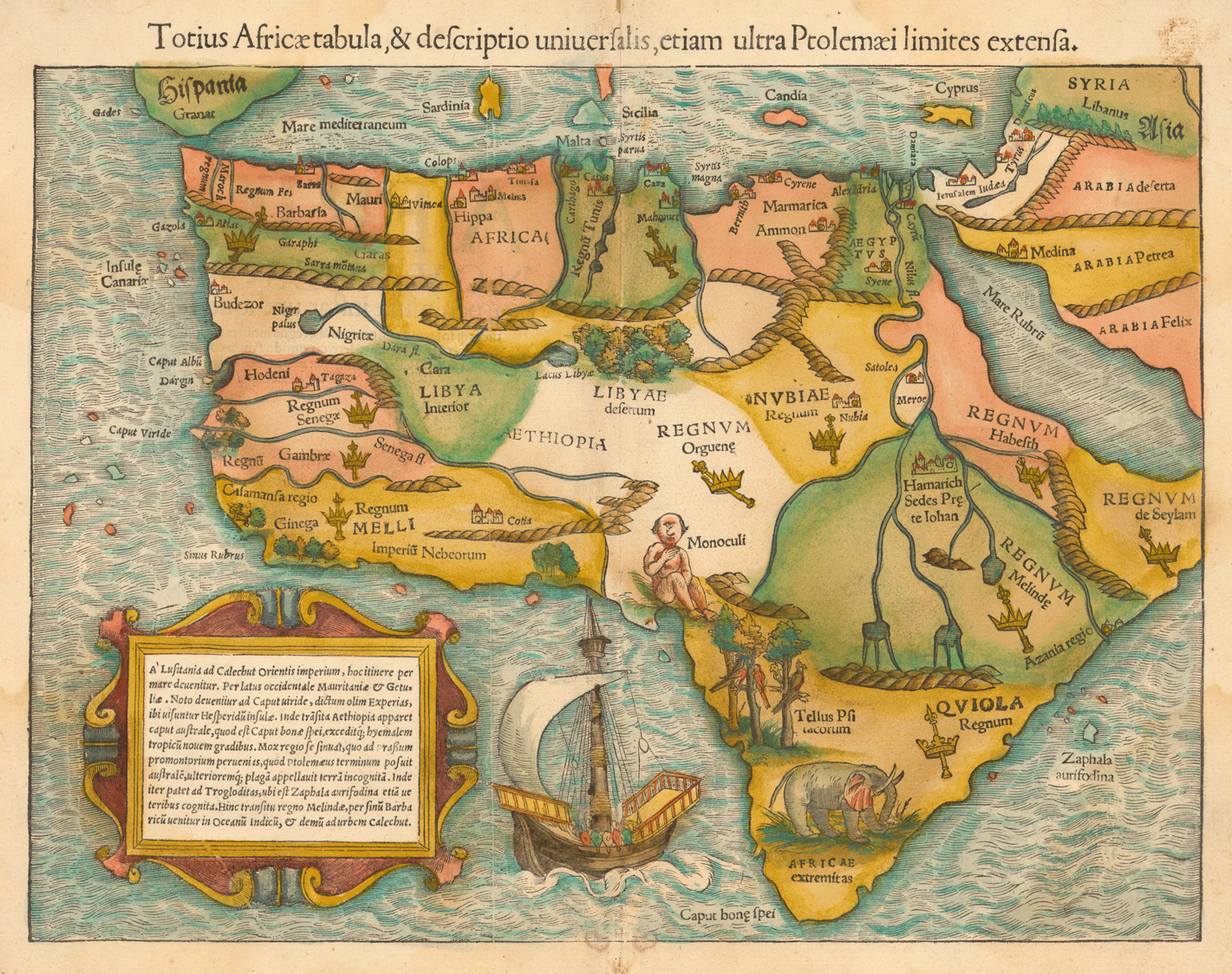
Prior to the 1400s, small amounts of gum arabic were exported to Europe by Egypt. In the 1400s, however, Portugese traders became the first to find their way to central Africa by navigating rivers that flowed into the Atlantic ocean. Nomadic Berber people in the Sahara traded with them for this and other supplies.5
The gum was also found on the coasts of Senegal and Mauritania and traded for by the Portugese, French, and British.6 This substance opened up a “gum trade” and later on would lead to military conflicts in the region. Increased availability led to the substance being used by more people, including artists, and becoming more affordable overall.

IMAGE: Sebastian Münster, “Totius Africæ tabula, & descriptio uniuersalis, etiam ultra Ptolemæi limites extensa,” 1554 (woodcut map). Courtesy of Princeton Firestone Library.
A sample recipe from the Renaissance:
Jean (Jehan) le Bègue, De Coloribus Faciendis, 1431:
When mixing colors for painting in books, make a binder of the brightest gum arabic and water, as before, and mix it with all colors except green and ceruse (lead white), minium (red lead), and carmine. Salt green is unusable in a book. Spanish green should be made with wine, and if you want to make it darker, add a little of the juice of sword grass, or cabbage, or leeks. You should mix minium and ceruse, and carmine, with egg white.7
- Yebeyen, Dagnew, Mulugeta Lemenih, and Sisay Feleke. “Characteristics and quality of gum arabic from naturally grown Acacia senegal (Linne) Willd. trees in the Central Rift Valley of Ethiopia,” Food Hydrocolloids, Volume 23, Issue 1, January 2009, p. 175-180. <https://www.sciencedirect.com/science/article/abs/pii/S0268005X07002676> ↩︎
- Gum Arabic that comes from Acacia seyal is sometimes called Talha. ↩︎
- de Bonnaventure, Constance. 2024. Gum Arabic and Its Secrets. Normandy, France: Alland & Robert. ↩︎
- Pliny, tr. H. Rackham. 1952. Natural History, Book 35, section 43. Manuscript is currently available online: https://www.attalus.org/pliny/hn35a.html ↩︎
- van Dalen, Dorrit. 2020. Gum Arabic: The Golden Tears of the Acacia Tree. Dordrecht, Netherlands: Leiden University Press. ↩︎
- de Bonnaventure ↩︎
- The full source can be readily obtained in Merrifield, Mary P. 1999. The Book of Medieval and Renaissance Treatises on the Arts of Painting: Original Texts with English Translations. Dover Publications.
Accessible online here: https://archive.org/details/medievalrenaissa0000unse_c2w5 ↩︎
Leave a Reply